
Tag: business funding UK

  • Business Cash Advance for Small Business UK: The Ultimate Guide to Flexible Funding

    Business Cash Advance for Small Business UK: The Ultimate Guide to Flexible Funding

    Did you know that over half of UK small business loan applications are currently rejected by major banks? It’s a discouraging reality for any owner trying to scale. When you do secure a traditional loan, you’re often stuck with rigid repayments that don’t account for seasonal dips or quiet weeks. We know that fixed monthly costs create unnecessary stress. A business cash advance for small business UK offers a fairer, more transparent way to bridge the gap.

    You deserve a financial partner that understands your daily challenges. You’ll discover how to secure flexible, revenue-linked capital to grow without the weight of fixed monthly bills. This guide covers everything from quick access to working capital to why this model keeps your personal assets safe. We’ll explain how to turn your future card sales into immediate growth, ensuring your repayments always mirror your actual daily turnover.

    Key Takeaways

    • Understand how a business cash advance for small business UK works by linking repayments to your daily card sales, ensuring you only pay back when you are making money.
    • Learn why this flexible funding model is often accessible within 48 hours, bypassing the lengthy and complex application processes of traditional high-street banks.
    • Discover the peace of mind that comes with unsecured capital, allowing you to grow your business without putting personal or commercial assets at risk.
    • Identify the straightforward eligibility requirements, focusing on your recent turnover and trading history rather than just a traditional credit score.
    • See how PurePay Hub simplifies the process by integrating funding directly with your existing payment systems for automated, stress-free management.

    Running a local shop or a seaside cafe in Britain means living by the rhythm of the seasons. You might see a surge in turnover during the summer holidays, only to face a quiet stretch once the school term starts. This volatility is a natural part of the business cycle, but it often clashes with the rigid expectations of traditional lenders. High-street banks typically operate on a one-size-fits-all model. They provide a lump sum and demand a fixed monthly repayment, regardless of whether your till was ringing or silent that week. It’s a system built for stability, not the reality of independent trade.

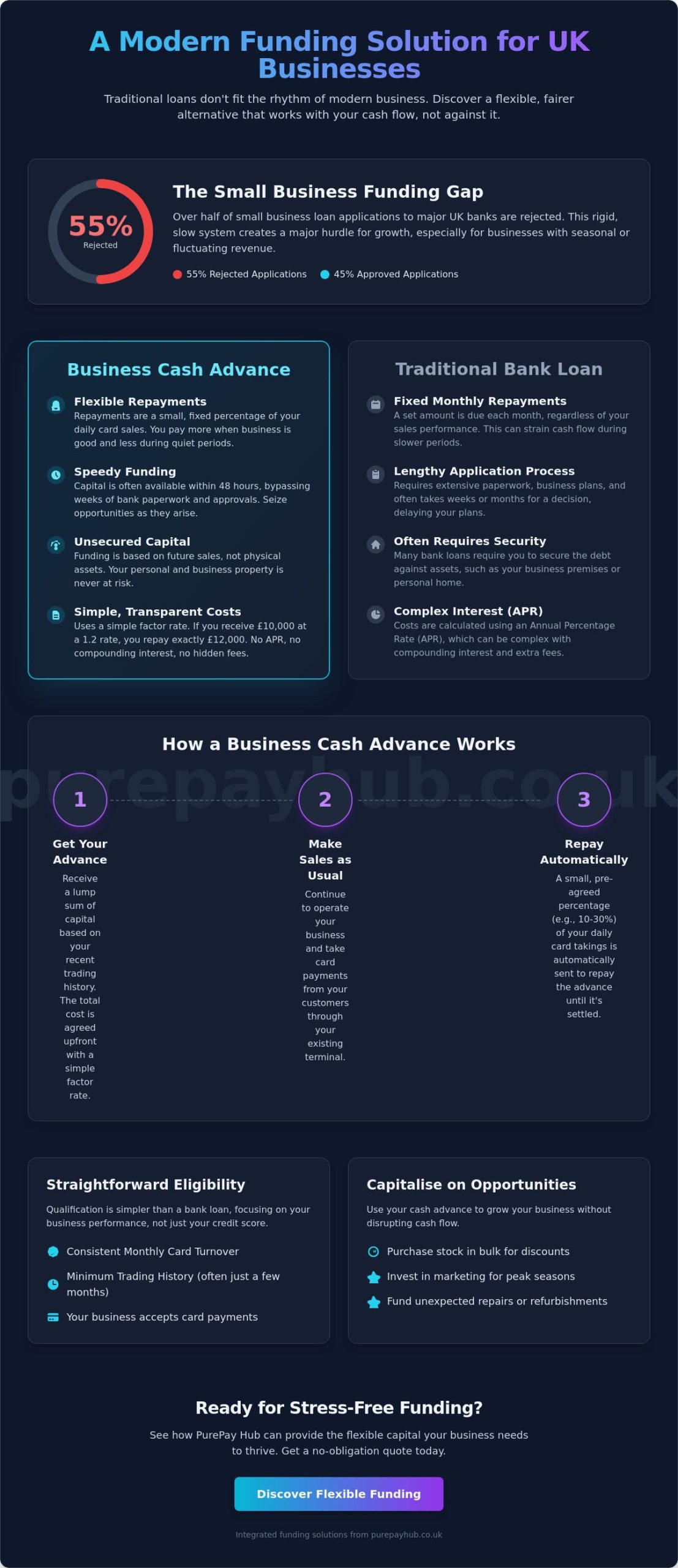
    This mismatch creates a “funding gap”. It’s the moment when your ambition for growth outpaces your available working capital. According to industry data from 2023, the success rate for SME loan applications at major banks dropped to just 45 per cent. Conventional banking is often too slow and too restrictive to help. Whilst-you-wait funding models, such as a What is a Merchant Cash Advance?, offer a modern alternative. They prioritise speed and adaptability over lengthy paperwork and fixed schedules. A business cash advance for small business UK bridges this gap by aligning your repayments with your actual sales.

    The Burden of Fixed Monthly Repayments

    Fixed repayments can quickly drain your cash reserves during quiet trading periods. If revenue doesn’t meet your projected targets, the pressure to find that monthly instalment becomes a major source of stress. It’s a significant risk of default that many owners simply can’t afford. This is why more UK SMEs are moving away from rigid financial structures. They want a partner that shares the risk. When your sales are lower, your repayments should be too. It’s a fairer way to manage debt without compromising your daily operations or staff wages.

    Capitalising on Immediate Business Opportunities

    Business doesn’t wait for a bank’s committee to meet. Sometimes you need to move fast. Securing a bulk-buy discount from a supplier can significantly improve your margins, but only if you have the cash ready. A business cash advance for small business UK provides that agility. It allows you to fund emergency repairs to vital equipment, like your countertop card machines or shop fittings, without disrupting your cash flow. You can also use this capital to invest in targeted marketing during peak UK shopping seasons, like the lead-up to Christmas or bank holiday weekends. This ensures you’re always ready to capture demand when it arrives.

    What is a Business Cash Advance? Revenue-Based Funding Explained

    A business cash advance for small business UK is an unsecured capital injection based on future card takings. Unlike a traditional bank loan, this isn’t money you “borrow” in the conventional sense. It is technically a purchase of your future credit and debit card sales. A provider gives you a lump sum upfront, and in exchange, they buy a specific portion of your future revenue at a fixed cost. This distinction is vital because it changes how the funding is regulated and how you manage it daily.

    The entire process is managed through your merchant account, which serves as the automated hub for the transaction. There’s no need to set up standing orders or worry about missing a deadline. Your card terminal communicates directly with the provider to facilitate the repayment. This level of integration is supported by industry bodies like The British Merchant Cash Advance Association, which helps maintain high standards of transparency across the UK’s alternative finance sector.

    Understanding the Factor Rate vs APR

    One of the biggest hurdles in traditional finance is the complexity of interest rates. Banks often use an Annual Percentage Rate (APR), which can be difficult to calculate when compound interest and monthly fees are added. A business cash advance for small business UK uses a factor rate instead. This is a simple multiplier applied to the advance amount. If you take an advance of £10,000 at a factor rate of 1.2, your total repayment is £12,000. You won’t face fluctuating interest or late payment penalties. This no-nonsense approach ensures you know exactly what the funding costs before you spend a single penny.

    The Repayment Mechanism: Pay as You Earn

    The “sweep” method is the engine behind this funding’s flexibility. Rather than a fixed monthly bill, a small percentage of your daily card sales is diverted to clear the balance. This percentage usually stays between 10 per cent and 30 per cent of your daily takings. The beauty of this system lies in its responsiveness to your trading volume. On a quiet Tuesday, you pay back very little. If you have a day with zero card sales, your repayments simply stop until the next customer taps their card. This ensures your working capital isn’t choked during slow weeks, allowing you to maintain a healthy cash flow whilst clearing the balance. You can check your eligibility for this type of funding through PurePay Hub’s business cash advance service.
    Business Cash Advance for Small Business UK: The Ultimate Guide to Flexible Funding

    Business Cash Advance vs. Traditional Loans: Which Suits Your SME?

    Choosing between a high-street bank and alternative finance is a pivotal decision for any merchant. Traditional loans are often slow. They require mounds of paperwork and can take weeks, or even months, to process. In contrast, a business cash advance for small business UK is designed for speed. You can often access funds within 24 to 48 hours of approval. This agility is essential when you need to settle a VAT bill or grab a time-sensitive stock opportunity. Traditional lenders lean heavily on your credit score and years of audited accounts. A cash advance looks at the health of your current trading instead. If you have a consistent history of card takings over the last 3 to 6 months, you are likely to qualify. It is a more inclusive way to fund a modern business.

    Criteria Business Cash Advance Traditional Bank Loan
    Speed of Funding 24 to 48 hours 3 to 6 weeks
    Security Required Unsecured (No assets) Secured (Property/Assets)
    Repayment Structure Flexible (Linked to sales) Fixed monthly amount
    Approval Basis Card sales history Credit score and accounts
    Cost Type Fixed factor rate Variable or fixed APR

    Fixed vs. Flexible Repayment Models

    Imagine a quiet month where footfall drops due to local roadworks or poor weather. With a bank loan, you still owe the same fixed amount. This creates a massive cash flow squeeze. The business cash advance for small business UK model removes this stress. Because it is revenue-linked, your repayments shrink during quiet times. There’s a significant psychological benefit to revenue-aligned debt. You don’t have to worry about defaulting during a seasonal dip because the system adjusts to your performance automatically. It keeps your business stable whilst you focus on bringing customers back through the door.

    Security, Collateral, and Personal Risk

    Most bank loans for SMEs are “secured”. This means you must pledge collateral, often your home or commercial property. If things go wrong, your personal assets are at risk. A cash advance is fundamentally different. It is an unsecured product. You aren’t putting your house on the line to get the capital you need. This protects your personal future and allows you to make smarter funding choices without the fear of losing everything. It is about empowering you to grow on your own terms, keeping your personal life separate from your business liabilities.

    Eligibility and Application: Preparing Your Business for Funding

    Securing a business cash advance for small business UK is a refreshingly direct process. Unlike the rigid gatekeeping of high-street banks, this funding model focuses on your current momentum. Most providers require a minimum monthly card turnover of between £2,500 and £5,000 to qualify. You also need a consistent trading history, typically spanning at least 3 to 6 months. This ensures your business has a proven track record of card transactions that can support the repayment structure. Eligibility is primarily based on card sales volume rather than just a credit score.

    One major advantage of this approach is the use of “soft search” credit checks. Traditional loan applications often leave a permanent mark on your credit report. This can negatively impact your score, especially if you apply to multiple lenders in a short period. A soft search allows providers to assess your suitability without affecting your credit rating at all. It is a transparent and risk-free way to explore your options. Your merchant service statements act as the primary evidence of your ability to repay, providing a clear picture of your daily takings and customer behaviour.

    The Application Checklist

    To ensure a smooth approval, you should have your documentation ready. You will typically need your last three to six months of merchant account statements to demonstrate your turnover. You also need proof of business identity and valid UK bank account details where the funds will be deposited. When presenting your turnover, ensure it is accurate and reflects your average monthly performance. This clarity helps providers offer you the best possible factor rate. It reduces the perceived risk and proves your business is a stable partner for development.

    Timing Your Advance for Maximum Impact

    Strategic timing is key to making the most of your capital. Many UK merchants apply for funding just before peak seasons, such as the Christmas rush or the summer holiday period. This allows them to stock up on inventory or hire extra staff when demand is highest. You might also consider an advance before a planned renovation or to replace aging equipment. However, it is vital to avoid over-leveraging. Only take what your future sales can comfortably support. Planning your funding around these cycles ensures the capital drives real growth rather than just covering existing gaps. Ready to take the next step? You can apply for a business cash advance through PurePay Hub and get a decision quickly.

    Securing Flexible Capital with PurePay Hub Merchant Services

    PurePay Hub approaches finance differently. We don’t view funding as a separate, distant service. Instead, we integrate the business cash advance for small business UK directly into our payment ecosystem. This centralised approach means your funding is perfectly aligned with your card processing. Whether you use our Countertop Card Machine, Portable Card Machine, or Mobile Card Machine, your hardware becomes a gateway to flexible capital. We understand that waiting weeks for a bank’s decision isn’t an option for a busy merchant. That’s why we offer next-day funding for our partners, ensuring you have the liquidity to act when opportunities arise.

    Our commitment to transparency is absolute. We’ve built our reputation on a no-nonsense approach that avoids the murky fee structures of traditional competitors. You won’t find hidden markups or complex corporate jargon here. We position ourselves as a fair partner to regional business owners, providing the clarity you need to manage your finances with confidence. Transitioning from a standard merchant to a funded partner is a seamless journey designed to support your long-term development. We act as a stabilising force, helping you turn daily turnover into a tool for sustainable growth.

    Transparent Processing and Integrated Funding

    There is a massive advantage in having your payment processor and funding facilitator under one roof. It removes the friction often found when dealing with multiple third parties. Our low transaction rates, starting at 0.3 per cent for debit cards, ensure you keep more of your hard-earned profit. Because the system is integrated, your reporting is simplified. You can track your daily sales and your advance repayments in one single, clear dashboard. This level of visibility prevents the confusion that often leads to cash flow stress, providing a clear path for your business’s finances.

    Getting Started with PurePay Hub

    Joining PurePay Hub is a straightforward process that prioritises your time. Our onboarding is fast, often taking just 10 to 15 minutes, with terminals delivered within 48 hours. If you’re already trading, switching to us is just as simple. You’ll gain access to our dedicated, UK-based support team who are ready to answer any questions about your funding or your hardware. We don’t hide behind automated bots or distant call centres. We are local experts committed to your success. If you’re ready to secure the capital your business needs to scale, you can Enquire about a Business Cash Advance with PurePay Hub today.

    Elevating Your Business with Flexible Funding

    Traditional banking often leaves UK merchants feeling constrained by rigid terms and slow processes. You’ve seen how revenue-linked capital offers a fairer alternative, aligning your repayments with your actual daily sales. By choosing a business cash advance for small business UK, you protect your personal assets whilst gaining the agility to invest in stock or equipment exactly when you need it. It is a modern solution designed for the unique rhythms of the British high street, ensuring you never pay more than you can afford during quieter trading periods.

    PurePay Hub is here to simplify your growth journey with a commitment to total transparency. We provide next-day access to funds and debit card rates starting from 0.3 per cent; all supported by our dedicated UK-based expert team. We believe in straight-talking finance without the hidden markups or complex jargon that often complicates business development. Ready to transform your future card sales into immediate, usable working capital? Apply for a transparent Business Cash Advance today and take the next step with confidence. Your business has the potential to scale, and we are ready to provide the flexible tools to make it happen.

    Frequently Asked Questions

    What is the maximum amount I can borrow through a business cash advance?

    The amount you can secure is typically based on your average monthly card turnover. Most providers offer between 100 per cent and 200 per cent of your typical monthly sales volume. This ensures the advance remains manageable for your specific business size. If your average monthly takings are £10,000, you might access a lump sum up to £20,000 depending on your trading history and risk profile.

    How long does it take for the funds to reach my UK business bank account?

    Funds can reach your account in as little as 24 to 48 hours following approval. The digital application process is designed for speed; bypassing the weeks of manual checks required by traditional lenders. Once you have submitted your merchant statements and passed the soft search, the capital injection is processed quickly. This makes a business cash advance for small business UK an ideal choice for urgent stock needs or emergency repairs.

    Can I get a business cash advance if I have a poor credit history?

    Yes, you can still qualify even if you don’t have a perfect credit score. Providers prioritise your recent card sales and trading consistency over historical credit data. Because the funding is unsecured and linked to your future revenue, your ability to generate daily sales is the most important factor. This inclusive approach helps many independent merchants who have been unfairly turned away by high-street banks.

    Do I have to switch my card machine provider to get a cash advance?

    You don’t always have to switch; however, using an integrated provider like PurePay Hub simplifies the entire process. When your card machine and funding are aligned, repayments are automated through your daily takings without any manual intervention. If you are currently with another provider, switching to our countertop or portable machines can often unlock better transaction rates alongside your funding.

    Is there an interest rate or APR associated with a business cash advance?

    No, these products do not use interest rates or an Annual Percentage Rate (APR). Instead, you pay a fixed cost determined by a factor rate; which is agreed upon at the start. This means you’ll know exactly how much you will pay back from day one. There are no compound interest charges or late payment fees; ensuring total transparency for your business’s financial planning.

    What happens to my repayments if my card machine is broken or I am on holiday?

    Your repayments automatically pause or slow down if you aren’t processing card sales. Since the “sweep” mechanism takes a pre-agreed percentage of each transaction, zero sales means zero repayments. This provides a natural safety net during holiday closures or equipment downtime. You won’t face the stress of a fixed monthly bill whilst your till is silent; allowing you to focus on getting back to trade.

    Are there any restrictions on how I use the cash advancement?

    There are generally no restrictions on how you utilise the capital within your business. You can use a business cash advance for small business UK to settle tax bills, purchase seasonal stock, or invest in new marketing campaigns. Whether you need to upgrade your EPOS systems or fund a shop renovation; the choice is entirely yours. We provide the capital, and you provide the expertise to grow.

    Can start-up businesses in the UK apply for a merchant cash advance?

    Brand new start-ups usually need to establish a short trading history before they can apply. Most providers require at least 3 to 6 months of consistent card processing data to assess your average turnover. Once you have this baseline of sales, you can apply for funding to help scale your operations. It is an excellent secondary step for businesses that have moved past the initial launch phase.

  • Merchant Cash Advance vs Business Loan: 2026 UK Funding Guide

    Merchant Cash Advance vs Business Loan: 2026 UK Funding Guide

    Why should your business be forced to pay a fixed monthly fee during a quiet trading week just because you needed capital six months ago? It is a common frustration for merchants who find that traditional bank structures don’t account for the natural ebb and flow of British high street trade. When you compare a merchant cash advance vs business loan UK providers offer very different paths that directly impact your monthly cash flow.

    We know that rigid repayment schedules and complex applications feel like a barrier rather than a bridge to growth. You need a funding partner that prioritises transparency over fine print and offers repayments that actually breathe with your daily card sales. This guide explores the critical differences between these models to help you secure the fairest funding for your business. We will show you how to access capital within 48 hours and explain why a sales-aligned repayment structure might be the stabilising force your finances need in 2026.

    Key Takeaways

    • Learn how to choose between a merchant cash advance vs business loan UK by matching your repayment structure to your actual daily card sales.
    • Understand the “pay-as-you-trade” model that automates deductions through your card terminal, protecting your cash flow during quieter trading periods.
    • Discover the specific eligibility criteria that allow merchants with limited trading history or varied credit scores to access capital in as little as 48 hours.
    • Identify high-impact use cases for cash advances, such as seasonal stock replenishment and emergency repairs, where speed and flexibility are paramount.
    • Explore the benefits of centralising your payment processing and funding through PurePay Hub to ensure total transparency and a simplified financial overview.

    Defining the Two Pillars of UK SME Finance

    For decades, the high street bank manager held the keys to business growth. That era has ended. Today, UK SMEs are increasingly looking beyond traditional banking halls to find capital that matches their modern trading patterns. With the Bank of England base rate sitting at 4.75% as of March 2026, the cost of borrowing has become a central concern for every shop owner and restaurateur. This shift toward alternative finance isn’t just about speed; it’s about finding a model that doesn’t penalise a business for having a slow month.

    When you evaluate a merchant cash advance vs business loan UK options, you’re essentially choosing between a rigid financial contract and a flexible sales partnership. Your merchant service provider often acts as the bridge here. They use your existing card terminal data to prove your business’s health, bypassing the mountain of paperwork that traditional lenders usually demand. It’s a no-nonsense approach that prioritises your actual trading history over a static credit score.

    What is a Merchant Cash Advance?

    Technically, a Merchant Cash Advance (MCA) is not a loan. It’s a commercial transaction where you sell a specific portion of your future credit and debit card sales in exchange for an immediate lump sum. This distinction is vital. Because it’s an advance on sales rather than a debt, there are no fixed monthly deadlines. If your sales drop during a quiet week, your repayments drop too. This flexibility reduces the financial anxiety that often keeps business owners awake at night. It’s also an unsecured form of capital. You don’t need to put your home or commercial property at risk to secure the funds.

    The Traditional Business Loan Explained

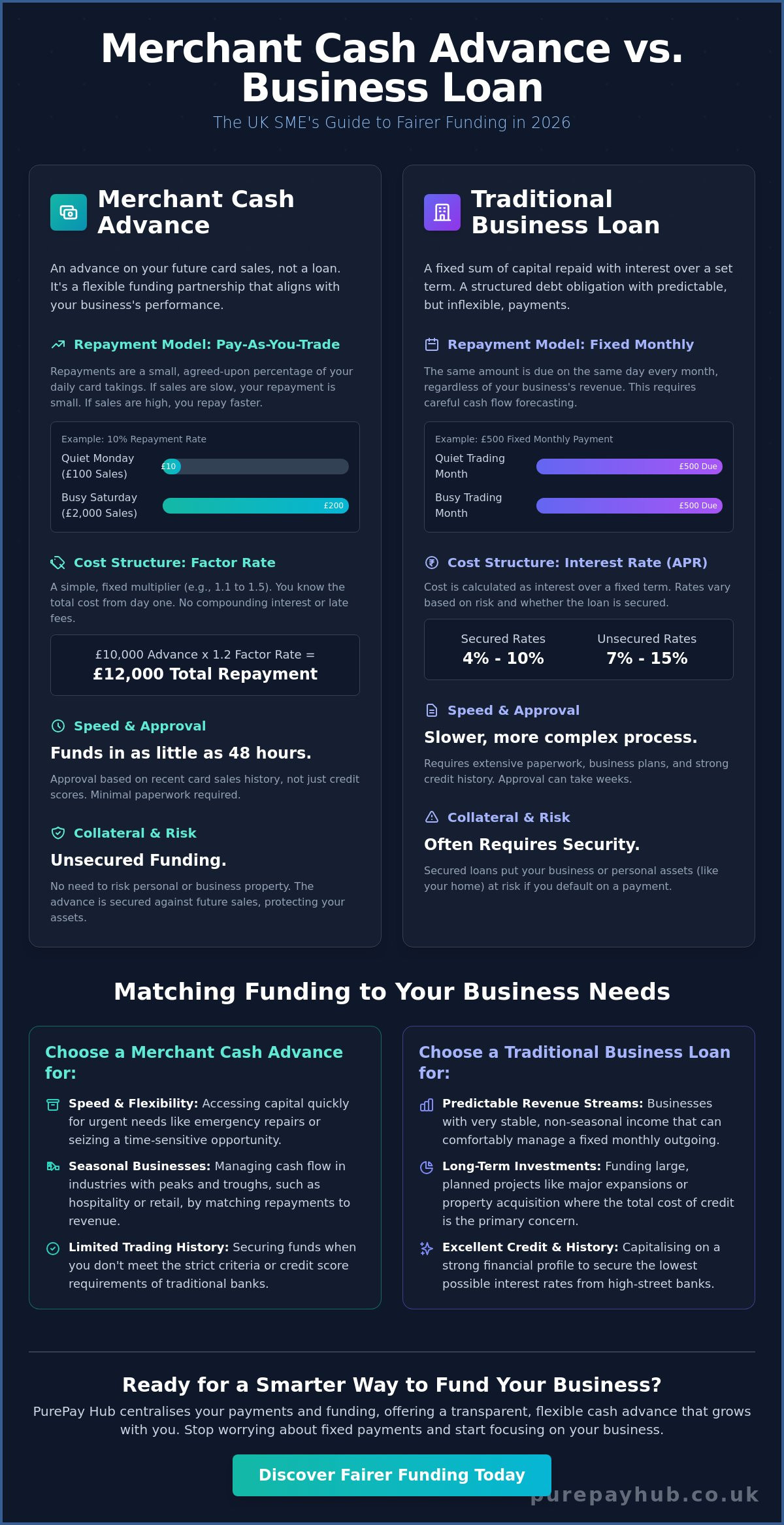
    A business loan follows a more familiar structure. You receive a principal amount and repay it, plus interest, over a set period, typically between one and five years. These payments are fixed. Whether you have a record-breaking month or your shop is closed for renovations, the lender expects the same amount on the same day. Most qualified UK SMEs find secured loan rates between 4% and 10%, whilst unsecured rates from high-street banks range from 7% to 15%. This model provides a clear end date for your debt, but it offers zero wiggle room when cash flow gets tight. It remains a popular choice for long-term investments where the total cost of credit is the primary concern.

    Analysing Repayment Structures: Fixed vs Flexible

    The fundamental difference between a merchant cash advance vs business loan UK business owners must understand lies in the repayment mechanics. One is a rigid debt. The other is a percentage of your success. Traditional loans are built on time, requiring you to pay back a set amount every month regardless of your bank balance. A merchant cash advance (MCA) is built on sales. It uses a pay-as-you-trade model that aligns perfectly with the reality of high-street commerce.

    To understand the cost, you must look at the factor rate rather than an APR. While bank loans use interest that can compound, MCAs use a fixed multiplier. Factor rates typically range between 1.1 and 1.5. If you receive an advance of £10,000 at a 1.2 factor rate, you pay back exactly £12,000. There are no hidden fees or late penalties because the total cost is agreed upon at the start. This transparency allows you to calculate your business cash advance costs with total certainty before you commit.

    How MCA Repayments Scale With Your Sales

    Imagine a rainy Monday in a seaside cafe. Footfall is low and card sales barely reach £100. With an MCA, if your agreed repayment is 10%, you only pay £10 that day. Fast forward to a sunny Saturday where sales hit £2,000; your repayment naturally scales to £200. This is known as the “sweep” method. The payment processor automatically splits the daily takings at the point of sale. You don’t need to manage the admin or set up standing orders. If you take zero sales on a bank holiday, you pay zero pounds. This structure removes the psychological weight of a looming monthly deadline.

    The Rigidity of Business Loan Schedules

    Traditional loans operate on a calendar, not a sales report. Whether you choose a high-street bank or a structured programme like UK Government Start Up Loans, you face a fixed monthly outgoing. These loans are currently fixed at a 7.5% interest rate for 2026, which is excellent for businesses with highly predictable, non-seasonal income. However, for most merchants, this rigidity creates risk. A single underperforming month can lead to a technical default if you haven’t set aside enough cash to cover the fixed instalment. Loans demand precise forecasting, whereas advances adapt to your actual performance.

    Merchant Cash Advance vs Business Loan: 2026 UK Funding Guide

    The Critical Differences: Eligibility and Transparency

    Securing capital shouldn’t feel like an interrogation. Yet, for many merchants, the traditional bank application process is exactly that. When you weigh up a merchant cash advance vs business loan UK lenders generally fall into two camps: those who look at your past and those who look at your potential. Traditional banks demand a “heavy” documentation trail, often requiring three years of audited accounts and a near-perfect credit score. PurePay Hub takes a different approach. We focus on the health of your daily card sales, making the process faster and far more inclusive.

    The core of this transparency lies in how we evaluate your business. Rather than obsessing over personal financial history, we prioritise your merchant statement history. This data provides a real-time picture of your business performance. It shows us your consistency and your customer volume. If you want to see how this fits into the broader financial ecosystem, you can read the official government definition of a Merchant Cash Advance. This model ensures that your funding is based on what your business actually does, not just what a credit agency says about you.

    Credit Scores and Approval Rates

    Will a poor credit score stop you from growing? In the world of high-street banking, the answer is often yes. However, MCA providers typically look for just 3–6 months of consistent card processing behaviour. We understand that a business owner’s personal credit history doesn’t always reflect the strength of their shop or restaurant. This makes a cash advance an accessible option for newer businesses that have been trading for at least six months. Approval rates in this sector are significantly higher because the risk is tied to your future sales, which we can see evidence of in your daily terminal activity.

    Understanding Factor Rates vs APR

    Transparency is our standard. Traditional loans use an Annual Percentage Rate (APR), which can be confusing when applied to short-term, flexible funding. Instead, we use a Factor Rate. This is a simple multiplier applied to the total sum you receive. For example, a 1.2x factor rate on a £10,000 advance means you pay back £12,000 in total. There are no compounding interest charges or hidden monthly fees to worry about. A factor rate provides a fixed total cost of capital that never increases, regardless of how long it takes to repay. This clarity allows you to plan your stock purchases or marketing campaigns without fearing a spike in costs if sales fluctuate.

    Strategic Suitability: Matching Funding to Your Business Model

    Choosing the right path when comparing a merchant cash advance vs business loan UK wide depends entirely on your specific objective. It isn’t just about finding the lowest headline rate. It’s about the strategic fit for your daily operations. If you need to fix a broken oven in a busy restaurant or stock up for a summer festival, the “cost of waiting” for a traditional bank can far outweigh the cost of capital. Losing two weeks of trading whilst waiting for a bank manager’s approval is a heavy price to pay for a slightly lower interest rate.

    A simple framework helps determine which model suits your current needs. Ask yourself: will this capital generate immediate revenue or solve an urgent bottleneck? If the answer is yes, a flexible advance is often the superior choice. Use this quick guide to align your funding with your goals:

    • Short-term revenue drivers: Use a cash advance for stock replenishment, seasonal marketing, or emergency repairs.
    • Long-term infrastructure: Use a traditional loan for commercial property purchases or multi-year research projects.
    • Cash flow management: Use an advance to bridge the gap during quiet months without adding fixed debt.

    Why Seasonal Businesses Favour Merchant Advances

    Hospitality and retail merchants face unique pressures that traditional lenders often ignore. The “January dip” often follows a frantic December, leaving cash reserves low just when you need to prepare for the spring. An MCA acts as a vital buffer during these fluctuations. Because providers can often deliver funding within 24 to 48 hours, it’s the ideal solution for sudden stock opportunities or equipment failure. You don’t have to worry about fixed repayments during your quietest weeks. Your funding behaves like your business; it scales down when the streets are empty and catches up when the tourists return.

    When a Traditional Loan Remains the Better Choice

    For long-term capital projects, a traditional loan is still a formidable tool. If you’re a B2B service provider who doesn’t process high volumes of card payments, an MCA won’t be an option. Loans are also better suited for purchasing commercial property or investing in significant structural renovations. Businesses with substantial assets can often leverage them to secure interest rates between 4% and 10%. This lower cost of credit makes sense when you have the luxury of time and a highly predictable income stream that won’t be shaken by seasonal shifts.

    If your business relies on daily card transactions and you need a partner that understands your rhythm, you can apply for a business cash advance today and receive a transparent decision in hours.

    Streamlining Your Cash Flow with PurePay Hub

    Most financial institutions treat your card processing and your business funding as two entirely separate worlds. This fragmentation creates unnecessary friction for busy merchants. When you compare a merchant cash advance vs business loan UK providers often make you jump through hoops with different companies. PurePay Hub removes this complexity. We bring your terminal and your capital under one roof. It’s a modern approach that turns your daily sales data into a powerful growth tool.

    Integrated Payments and Funding

    Our card machines do more than just process transactions. They provide the real-time insights needed for instant funding decisions. Because we see your trading volume directly, we don’t need to ask for stacks of bank statements or audited accounts. This integration allows for a seamless “pay-as-you-trade” experience. You get one clear monthly statement that covers both your processing fees and your advance repayments. We keep our debit rates starting from 0.3%, ensuring that more of your hard-earned profit stays exactly where it belongs; in your business bank account.

    Having your funding source and your card terminal linked simplifies everything. There are no manual transfers to manage and no risk of missing a fixed deadline. The system handles the split automatically. This gives you next-day access to funds when you need them most, providing a level of agility that traditional loans simply cannot match. It is about making your finances work as hard as you do.

    Getting Started: The Next Steps

    We believe in straight-talking and calm advocacy. We aren’t here to push debt; we’re here to help you choose the route that fits your actual turnover. Our application process is designed to be as efficient as your business. It follows a simple three-step path: Connect your terminal data, Assess your eligibility with our team, and receive your Fund. It’s a no-nonsense consultation that puts you in control of your cash flow.

    If you’re ready to move away from the rigid structures of the past, we’re here to help. You can Explore our Business Cash Advance options today and discover how integrated funding can stabilise your finances. Whether you’re looking to upgrade your EPOS system or simply need a buffer for a quiet month, we’ll find a solution that breathes with your business.

    Securing a Fairer Financial Future for Your Business

    Choosing between a merchant cash advance vs business loan UK wide comes down to how you want your capital to behave. If your business thrives on daily card sales, you shouldn’t be tethered to a rigid monthly debt that ignores your quietest weeks. You’ve seen how flexible repayments and inclusive eligibility can remove the barriers to growth that traditional banks often maintain. By aligning your funding with your actual turnover, you protect your cash flow whilst keeping your momentum high.

    PurePay Hub is here to act as your supportive business ally. We offer a transparent approach with debit card rates from 0.3% and next-day funding as standard. There are no hidden markups or corporate jargon to decode; just clear, honest service designed for local merchants. It’s time to trade on your own terms with a partner that values your success as much as you do.

    Ready to take the next step? Get a transparent quote for your business funding today and see how simple integrated finance can be. We look forward to helping your business flourish throughout 2026 and beyond.

    Frequently Asked Questions

    What is the main difference between a merchant cash advance and a business loan?

    The primary difference involves how you repay the capital. A traditional loan requires fixed monthly instalments regardless of your income. In contrast, a merchant cash advance is a purchase of future card sales where repayments fluctuate based on your daily takings. This makes the merchant cash advance vs business loan UK choice a matter of choosing between rigid debt and flexible sales-linked funding that protects your cash flow.

    Can I get a merchant cash advance with a poor credit score in the UK?

    Yes, you can often secure funding even with a less-than-perfect credit history. MCA providers prioritise your recent card processing volume over your historical credit score. If your business has been trading for at least six months and shows consistent card turnover, you are likely to be eligible. This inclusive approach focuses on your current business health rather than past financial hurdles that might stop a bank loan.

    How much does a merchant cash advance cost compared to a loan?

    Traditional loans typically have lower headline interest rates, with secured APRs often between 4% and 10% in 2026. Merchant cash advances use a factor rate, usually between 1.1 and 1.5, which can result in a higher equivalent APR. You are essentially paying for the convenience of speed and the flexibility of repayments that drop when your sales do. It is a trade-off between the lowest cost and the best cash flow protection.

    Do I need to change my card machine provider to get an MCA?

    You don’t always need to switch, but using an integrated provider simplifies the process significantly. When your card terminal and funding source are under one roof, the data flows seamlessly for faster decisions. We can often work with your existing setup, but our own terminals ensure you benefit from our lowest debit rates starting from 0.3% and automated, hassle-free repayments that require no manual admin.

    What happens to my repayments if my business has a slow month?

    Your repayments automatically decrease during a slow month. Because the provider takes a fixed percentage of your daily card sales, you only pay back what you can afford based on your actual income. If you have a week with zero sales, you make zero repayments. This pay-as-you-trade model removes the pressure of finding a fixed sum when footfall on the high street is unexpectedly low.

    How long does it take to get the money in my bank account?

    You can typically access the funds within 24 to 48 hours of approval. This is significantly faster than traditional bank loans, which can take weeks to process. The streamlined application focuses on your digital merchant statements, allowing for rapid assessment. Once you sign the agreement, the lump sum is transferred directly into your business bank account, providing the agility needed for emergency repairs or stock opportunities.

    Are there any hidden fees or late payment penalties with an MCA?

    There are no late payment penalties or hidden markups because there are no fixed deadlines. The total cost of the advance is agreed upon at the start using a transparent factor rate. Since your repayments are a percentage of sales, you can’t be late as long as you continue to process card payments. This structure provides total clarity regarding the total cost of credit from the very first day.

    Is a merchant cash advance regulated by the FCA?

    Merchant cash advances are not currently regulated by the Financial Conduct Authority (FCA) in the UK. This is because they are technically a purchase of future receivables rather than a traditional consumer or business loan. Because of this, it’s essential to partner with a transparent provider that prioritises honesty and clear fee structures. Conduct thorough due diligence to ensure your funding partner adheres to high standards of fairness.