
What if the quickest way to inject capital into your business was also the safest way to protect your financial reputation? Many UK business owners hesitate to seek funding because they fear how do business cash advances affect credit score or worry about the sting of a high-street bank rejection. It’s a common anxiety, especially when you’re trying to keep your personal and business finances distinct. You want to grow, but you don’t want a single application to lower your standing with lenders for the long term.
This guide explains why this flexible funding model is often the most credit-friendly way to boost your cash flow. We’ll explore the crucial difference between soft and hard searches, whilst explaining why a business cash advance doesn’t appear as traditional debt on your balance sheet. You’ll discover how to secure the funds you need based on your sales performance rather than just a credit number, ensuring you can move forward with confidence and clarity.
Key Takeaways
- Identify the difference between soft and hard credit searches to protect your rating whilst exploring new funding options.
- Understand how do business cash advances affect credit score and why they don’t appear as traditional debt on your balance sheet.
- Learn why the absence of fixed monthly deadlines means you can avoid the risk of damaging late payment markers on your report.
- Discover how using a cash advance to consolidate expensive, “noisy” debt can actually help you build a more stable financial profile.
- Find out how PurePay Hub prioritises transparency to provide capital based on your sales performance rather than just a credit number.
What is a Business Cash Advance and Why Does Credit Matter?
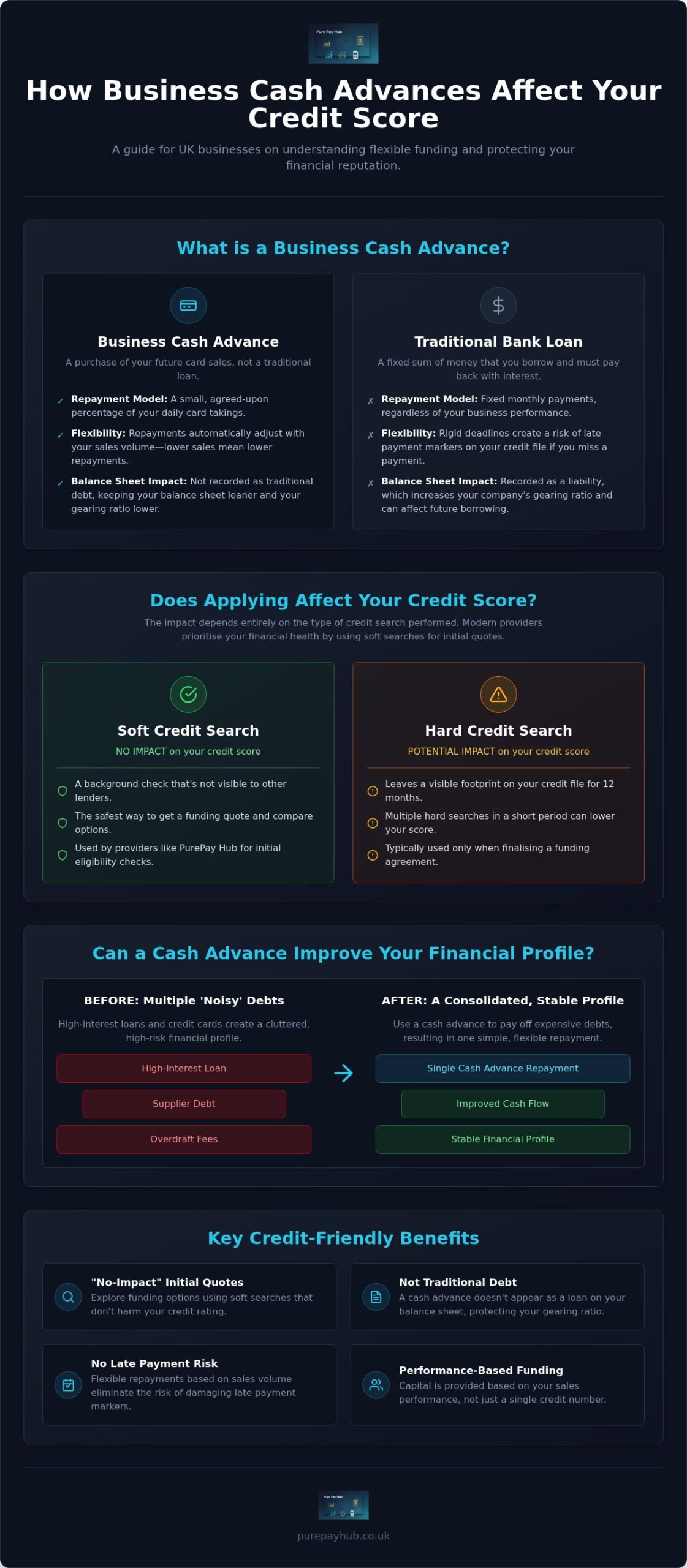
A business cash advance, often called a Merchant Cash Advance (MCA), is a modern alternative to traditional bank funding. It isn’t a loan. Instead, it is the purchase of your future credit card sales. A provider gives you a lump sum upfront, and you “repay” it through a pre-agreed percentage of your daily card takings. Because this is a commercial transaction rather than a credit agreement, the rules of the game change significantly. For many UK merchants, the most pressing question is how do business cash advances affect credit score and whether this funding will limit their future options.
Credit matters because it is the lifeblood of your long-term growth. If your credit file is cluttered with high-interest debt or multiple hard searches, traditional lenders may view your business as high risk. Understanding how an MCA interacts with your financial profile is the first step toward protecting your borrowing power.
The Fundamental Difference: Sales vs. Debt
Traditional loans are recorded as liabilities on your balance sheet. They come with fixed monthly interest rates and strict repayment deadlines. An MCA operates differently. Since you are selling a portion of future revenue, it is often viewed as a trade of assets rather than a standard debt. This distinction is vital for your “gearing ratio,” which measures your company’s debt against its equity. High gearing can make it difficult to secure mortgages or large-scale equipment finance later on. An MCA keeps your balance sheet leaner because it doesn’t carry the same “debt” label as a bank loan.
The lack of a fixed repayment schedule also changes the credit perspective. You don’t have a “due date” in the traditional sense. If your sales are slow one week, your repayments automatically drop. This flexibility prevents the risk of missed payment markers that often plague businesses with rigid bank loans.
Why Business Owners Fear Credit Score Changes
Anxiety around credit scores usually stems from a fear of the unknown. Traditional banks often perform “hard searches” the moment you enquire about a loan. These searches leave a permanent footprint on your file, and too many in a short period can lower your score. Business owners also worry that taking on new capital will “clog up” their credit capacity, making it impossible to react to emergencies.
PurePay Hub prioritises transparency to alleviate these concerns. We focus on your sales performance and card turnover rather than just a single credit number. By understanding how do business cash advances affect credit score, you can use this tool to boost cash flow without the “credit hangover” associated with high-street banks. Our goal is to act as a supportive partner, ensuring you stay in total control of your financial reputation whilst accessing the capital you need to scale.
Does Applying for a Cash Advance Affect Your Credit Score?
The short answer is: it depends on how you start the conversation. For many business owners, the fear of a “rejected” application appearing on their file is enough to stop them from seeking growth capital altogether. However, modern finance has evolved to be more merchant-friendly. Understanding how do business cash advances affect credit score begins with the very first click of the application button. If the provider uses the right tools, you can see your funding options without any risk to your financial standing.
The impact is determined by the type of credit search performed. Traditional banks often default to “hard” searches immediately. Modern fintech providers, however, prioritise your peace of mind by using “soft” searches for the initial stages. This allows you to shop around and compare rates without appearing desperate to other lenders. It’s a transparent way to do business that puts the power back into the hands of the SME owner.
Soft Searches: The “No-Impact” Way to Get a Quote
A soft search is essentially a background check that leaves no footprint on your credit file for other lenders to see. It is the safest way to gauge your eligibility. You should always ask a provider if they use soft searches before you share your details. If they can’t give you a straight answer, it’s a red flag. PurePay Hub helps you explore your funding options without damaging your reputation, ensuring you have the clarity needed to make an informed decision.
Because these checks aren’t visible to third parties, they don’t lower your score. You could technically have multiple soft searches in a single day and your credit rating would remain exactly the same. This is particularly useful for seasonal businesses that need to compare several offers to find the best fit for their specific turnover patterns.
When a Hard Search Becomes Necessary
Hard searches are a standard requirement for finalising any significant funding agreement in the UK. Once you’ve reviewed your quote and decided to progress to a full application, the lender will perform a deeper dive into your financial history. This is a formal record that you have applied for credit. While a single hard search may cause a small, temporary dip in your score, this usually recovers quickly if you manage your repayments well.
The real danger for SMEs isn’t a single hard search; it’s the “scattergun” approach. Applying for multiple loans or advances from different providers in a very short window can signal financial distress to credit bureaus. By working with a transparent partner, you can ensure that a hard search only happens when you’re confident in the deal, keeping your credit file clean and professional.
How Cash Advances Appear on Your Credit Report
One of the most significant advantages of a business cash advance is its “invisible” nature on a traditional credit report. When you take out a standard bank loan, it is registered as a formal liability. This debt is visible to any other lender who views your file. In contrast, a business cash advance is the purchase of future revenue. Because it isn’t a traditional loan agreement, it often doesn’t appear in the “Loans” section of your credit report. This distinction is crucial when you’re trying to understand how do business cash advances affect credit score compared to high-street products.
Repayment behaviour is the biggest driver of credit health. With a bank loan, a single missed payment can trigger a negative marker on your file. These markers stay for years and can sabotage future funding. An MCA removes this risk entirely. Repayments happen automatically as a pre-agreed percentage of your daily card sales. If you have a day with zero sales, you make zero repayments. There is no fixed “due date” to miss, so there are no “late payments” to report to credit bureaus. This automated flow keeps your credit profile clean and professional.
The Advantage of “Off-Balance Sheet” Funding
Because an MCA is often treated as an off-balance sheet transaction, it keeps your traditional credit lines open. If you need to apply for a mortgage, a vehicle lease, or a commercial overdraft, those lenders won’t see a massive outstanding loan balance competing for your income. High-street banks often view an MCA more favourably than a maxed-out overdraft or a revolving credit facility. It shows you’re managing cash flow through your own turnover rather than relying on high-interest debt. This maintains a healthy relationship between your capital and your actual sales performance.
Personal Guarantee and Credit Links
While the advance is a business transaction, most unsecured funding in the UK requires a personal guarantee. This is a standard commitment from the business owner. Under normal circumstances, this has no impact on your personal credit file. The two remain entirely separate. However, it’s vital to be aware that a total default could potentially bridge that gap. If the business fails to honour the agreement, the guarantee could then appear on your personal record. PurePay Hub ensures total clarity on these terms before you sign anything. We believe in straight-talking partnership, making sure you know exactly where the boundaries lie between your business and personal financial reputation.
Can a Business Cash Advance Help Improve Your Score?
While most owners focus on protecting their current rating, an MCA can actually be a tool for financial repair. It helps you move away from the rigid, often unforgiving structures of high-street banking. When you ask how do business cash advances affect credit score, you should also consider the positive ripple effects on your wider financial health. By using this capital strategically, you can clean up your credit file and position your company as a reliable partner for future growth.
Improved cash flow is the most immediate benefit. With next-day access to funds, you can ensure that suppliers, landlords, and utility companies are always paid on time. These entities often report payment behaviour to credit bureaus. Consistent, on-time payments build a “green” history on your file, which is the fastest way to see a score increase. A stronger business bank statement, showing healthy activity and no bounced direct debits, is often more valuable to a lender than the credit score itself.
Consolidating High-Interest Debt
Replacing high-interest credit cards or a maxed-out overdraft with an MCA can significantly boost your standing. Credit cards are “noisy” debt; they carry high utilisation rates that drag your score down. By using an advance to clear these balances, you reduce your credit utilisation ratio immediately. Lower credit utilisation directly improves a business score. You also gain the psychological and financial benefit of “paying as you earn,” rather than struggling with a fixed monthly interest charge that doesn’t care about your sales volume. For those also dealing with high-interest personal debt, Consolidate My Payday Loans provides a path to simplify multiple payments into a single, manageable plan.
Building a Track Record for Future Funding
Alternative lenders value consistency over perfection. Successfully completing a business cash advance makes you a “preferred” borrower in the eyes of the fintech community. It proves that your business has a reliable card turnover and that you can manage capital responsibly. This history acts as a trust signal. By establishing this track record now, you position your business for larger, cheaper funding opportunities in the future. You aren’t just getting a cash injection; you’re building a bridge to better financial products. If you’re ready to start building that history, you can apply for a business cash advance today and receive a transparent quote within minutes.
Choosing the Right Partner for Your Business Growth
Finding the right partner is about more than just finding a lump sum of cash. It’s about finding a team that respects your hard-earned reputation. PurePay Hub acts as a supportive ally to regional business owners, offering a fair and transparent alternative to the opaque practices of traditional banks. We provide a seamless link between your card machine and your funding, ensuring that your capital works as hard as you do. When you’re considering how do business cash advances affect credit score, the integrity of your provider is the most important factor in the equation.
We prioritise clarity over corporate jargon. Our model is built on next-day access to funds and repayments that mirror your daily sales performance. There are no hidden markups or murky fee structures to worry about. By focusing on your actual turnover rather than an arbitrary credit number, we help you maintain fluid cash flow whilst you focus on scaling your operations. We don’t just provide capital; we provide a stabilising force for your business finances.
Integrated Payments and Funding
Working with an ISO that understands the UK merchant community makes a world of difference. Having your card machine and your cash advance under one roof simplifies your reporting and your life. Because we already understand your processing volume, we can offer tailored support that fits your specific industry. This integrated approach removes the friction often found with distant financial institutions, making PurePay Hub the preferred choice for businesses that value efficiency and straight-talking.
Ready to Explore Your Options?
You don’t need to risk your financial standing to see what’s possible. We make the process simple and secure. To get started, you only need to provide your card sales history. We use this data to build a quote that reflects the reality of your business, not just your past credit history. Most importantly, you can explore your options without a hard search on your file, giving you the freedom to plan for the future without any immediate impact on your score. If you’re ready to grow, you can see how much you can access with PurePay Hub today and secure the capital your business deserves.
Secure Your Future With Confidence
Protecting your credit rating shouldn’t mean pausing your growth. As we have explored, a business cash advance is a flexible, credit-friendly alternative to the rigid structures of high-street banking. By prioritising soft searches and sales-based repayments, you can access the capital you need without the “credit hangover” of traditional loans. Understanding how do business cash advances affect credit score allows you to make informed decisions that keep your balance sheet clean and your borrowing power intact.
PurePay Hub is here to act as your supportive partner. We provide next-day access to funds and no-nonsense UK-based support to ensure your journey is smooth and transparent. With debit card charges starting from 0.3%, we focus on providing a fair service that respects your bottom line. You deserve a funding partner that values your sales performance over a single credit number. Apply for a transparent Business Cash Advance today and take the next step in your business journey. Your growth is our priority, and we’re ready to help you scale on your own terms.
Frequently Asked Questions
Will a business cash advance appear on my personal credit report?
No, a business cash advance is a commercial transaction and doesn’t typically appear on your personal credit report. It remains separate from your personal finances unless you default on the agreement. Because most providers require a personal guarantee, the link only becomes active if the business cannot honour the repayment. This separation allows you to manage your company’s cash flow without impacting your ability to secure personal mortgages or car finance.
Does a merchant cash advance require a hard credit check?
Initial eligibility checks usually rely on soft searches, which have no impact on your rating. A hard credit check is only performed once you formally accept a quote and progress to the final application stage. This transparency allows you to explore multiple funding options without leaving a permanent footprint on your file. We always recommend asking a provider about their search policy before sharing your full financial details.
Can I get a business cash advance with a poor credit score?
Yes, you can often secure an advance even with a less than perfect credit score. Providers prioritise your card turnover and sales consistency over a single credit number. If your business shows healthy, regular daily takings, you are a strong candidate for funding. This approach makes it much easier for SMEs to access capital when traditional high-street banks have already said no based on rigid credit scoring.
What happens to my credit score if my sales slow down and repayments take longer?
Your credit score remains unaffected if your sales slow down. Because repayments are a fixed percentage of your daily card takings, the amount you pay back automatically adjusts to your turnover. If you have a quiet week, you simply pay less. There are no “late payment” markers or fixed monthly deadlines to worry about. This flexibility is what makes people ask how do business cash advances affect credit score differently than traditional bank loans.
Is a business cash advance considered a loan by credit reference agencies?
No, credit reference agencies don’t categorise a business cash advance as a traditional loan. It is legally defined as the purchase of future assets, specifically your future card revenue. This “off-balance sheet” nature means it doesn’t add to your traditional debt-to-income ratio. Keeping this distinction clear helps you maintain a cleaner credit profile when you need to apply for other types of commercial finance or equipment leases.
How does “stacking” multiple cash advances affect my business reputation?
Stacking multiple advances can signal financial distress to future lenders and providers. Whilst one advance is a stabilising force, taking out several simultaneously suggests you’re struggling to manage your cash flow. This behaviour can make it harder to secure competitive rates in the future. We advise focusing on one transparent agreement that matches your turnover rather than juggling multiple facilities that could eventually strain your daily operations.
Can I use a business cash advance to pay off a bank loan?
Yes, you can use the capital from an advance to clear existing bank loans or expensive credit card debt. Consolidating “noisy” debt into a single, sales-based repayment structure can actually help you understand how do business cash advances affect credit score positively. By removing fixed monthly liabilities and high credit utilisation from your file, you present a much healthier financial picture to credit bureaus and future business partners.
Why do lenders care about my card turnover more than my credit score?
Card turnover provides a real-time view of your business health and reliability. A credit score is a historical snapshot, but your daily sales show how your business is performing right now. Lenders value this consistent revenue because it provides a predictable flow of repayments. This performance-based model allows for next-day access to funds, ensuring that successful UK merchants aren’t held back by outdated banking metrics or old credit mistakes.