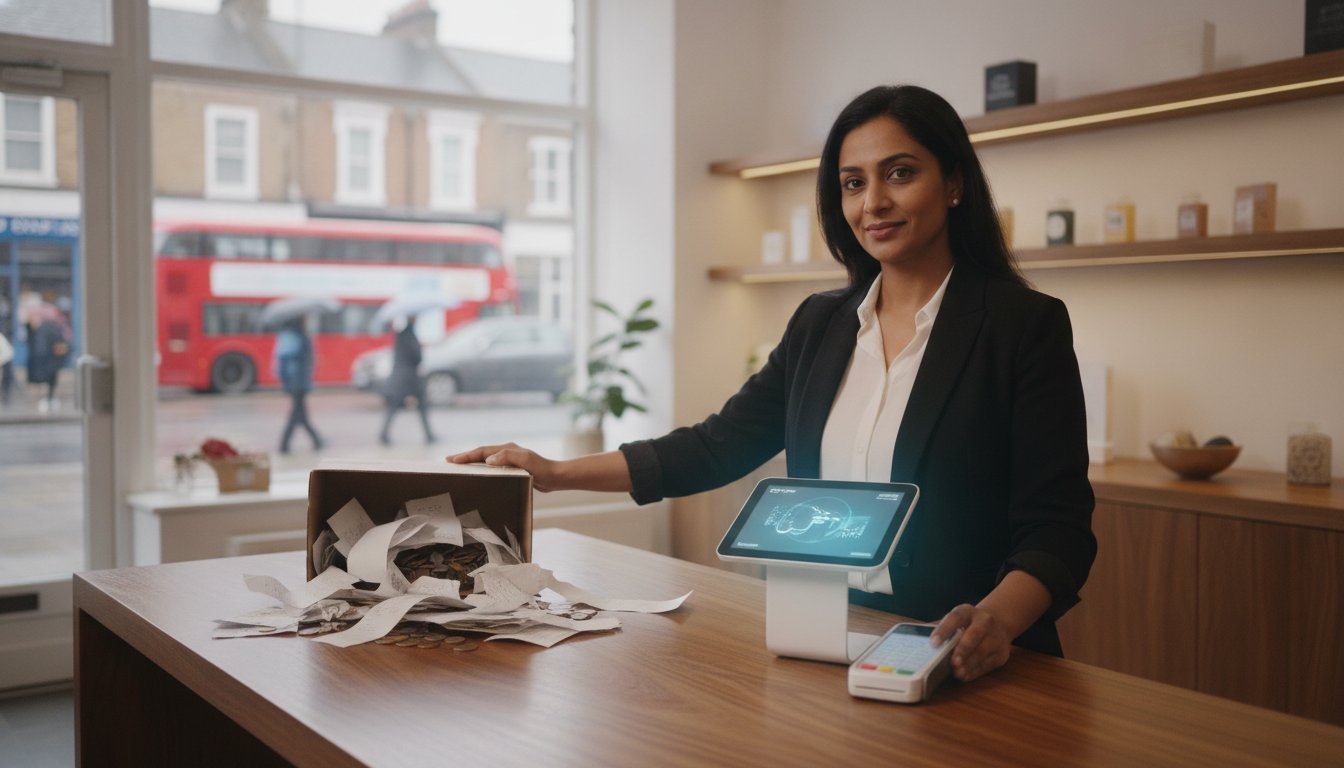
What if your most trusted accounting tool is actually your biggest financial liability? Many local business owners still rely on a physical container to bridge The Gap: The “Shoebox Method.” their “VAT Prep” then becomes a frantic, last-minute scramble that leads to missing receipts and manual errors. This outdated habit creates unnecessary stress before every deadline and leaves you vulnerable to HMRC audits. With late payment penalties starting at 3% after just 16 days, the cost of staying manual is simply too high.
We know that organising crumpled paper feels like a second job you never asked for. You deserve a clear, transparent way to manage your finances without the fear of a surprise tax bill. This article explains how to transition from chaotic record-keeping to automated VAT prep using modern payment technology. You will discover how integrated card machines and EPOS systems can deliver zero-error returns, lower your accountancy fees, and give you more time to focus on running your business with complete confidence.
Key Takeaways
- Understand why physical receipt storage is a financial liability and how it increases your risk of manual entry errors.
- Discover how to bridge The Gap: The “Shoebox Method.” their “VAT Prep” is then simplified through the use of integrated payment technology.
- Learn how integrated card machines and EPOS systems automatically categorise sales data to ensure zero-error returns.
- Identify common culprits of the ‘VAT Gap’ that cause businesses to lose money through missed transaction fees and incorrect rates.
- Follow a practical 2026 guide to align with Making Tax Digital using transparent, no-nonsense reporting from your payment provider.
What is the ‘Shoebox Method’ and Why is it Failing UK Businesses?
The ‘Shoebox Method’ is a traditional approach to bookkeeping where a business owner stores physical receipts, invoices, and petrol slips in a container for later processing. This container might be a literal shoebox, a plastic folder, or even a vehicle glove compartment. The intention is always the same: to deal with the paperwork when the VAT deadline looms. Whilst this felt like a simple solution in decades past, it has become a significant financial liability in 2026.
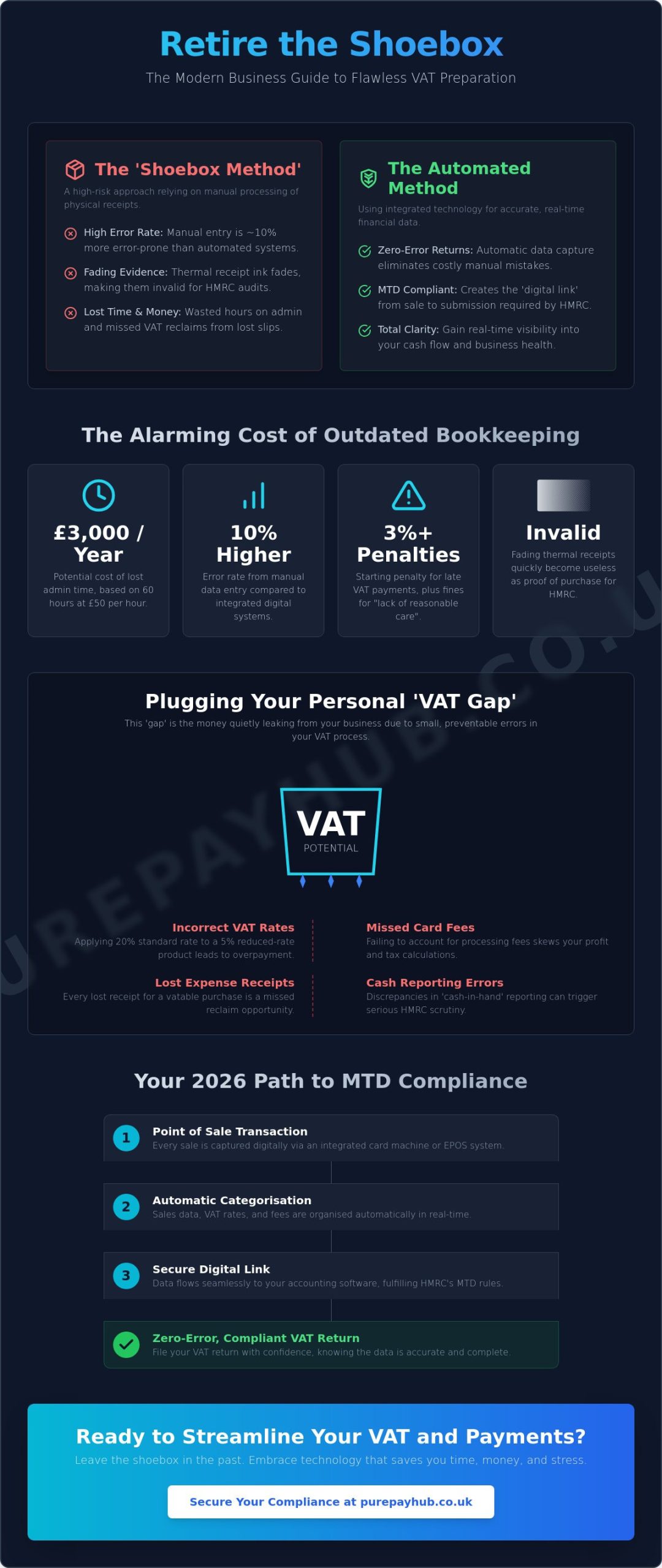
Bridging The Gap: The “Shoebox Method.” their “VAT Prep” becomes a source of immense pressure as the quarter ends. This behaviour is high-risk because physical paper is fragile. Thermal receipt ink fades within months, often leaving you with blank slips that HMRC will not accept as valid evidence. Beyond the physical risks, manual data entry is notoriously unreliable. Industry data suggests that manual entry leads to error rates roughly 10% higher than automated systems. These small mistakes, such as misreading a digit or missing a decimal point, can lead to overpaid tax or, worse, underpayment penalties.
The hidden cost of this manual prep is measured in hours lost. A typical sole trader might spend five hours every month organising crumpled paper and typing figures into a spreadsheet. Over a year, that is 60 hours of admin. If your time is worth £50 per hour, you are effectively paying £3,000 a year just to manage your own paperwork. Whilst the history of VAT in the UK shows a system that once relied on paper ledgers, HMRC now demands digital audit trails that a shoebox simply cannot provide.
The Psychological Toll of the Sunday Night Sort
Many business owners recognise the dread of the ‘Sunday night sort’ before a VAT return is due. This scramble to find missing records creates significant anxiety and often leads to missed VAT reclaims. If you cannot find a £100 receipt, you lose the ability to reclaim that £20. Over a year, these lost slips represent hundreds of pounds in vanished profit. Relying on physical storage acts as a ceiling on your growth; you cannot scale a business when you are buried in unorganised paper.
The Shift to Digital Record-Keeping
2026 is the year to finally retire the physical shoebox. Modern accounting is digital-first, prioritising clean data and real-time visibility. Moving to a digital system isn’t just about satisfying HMRC; it’s about understanding your cash flow. When every transaction is recorded electronically at the point of sale, you gain a clear picture of your business health. This clarity is the foundation for making informed decisions and securing the future of your company.
Understanding the VAT Gap: How Small Errors Cost You Thousands
HMRC defines the national VAT gap as the difference between the tax that should be collected and the amount actually received. For you, the gap is personal. It represents the difference between what you should be claiming or paying and what you actually file. When business owners fail to bridge The Gap: The “Shoebox Method.” their “VAT Prep” becomes a source of financial leakage rather than a robust accounting process. Small errors add up. A missed transaction fee here or an incorrectly applied tax rate there can quietly drain thousands from your bottom line over a single financial year.
Common culprits of this leakage include missed card processing fees, incorrect VAT rates on specific products, and discrepancies in ‘cash-in-hand’ reporting. If you mistakenly apply the 20% standard rate to a product that qualifies for the 5% reduced rate, you are overpaying tax that could have stayed in your business. Conversely, underpaying tax due to poor record-keeping triggers the HMRC ‘inaccuracy penalty.’ These penalties are calculated based on your behaviour; if HMRC deems an error resulted from a lack of ‘reasonable care,’ the costs can be substantial. Digital transparency isn’t just a modern convenience. It is your best insurance policy against a stressful audit.
HMRC’s Evolving Stance on Digital Evidence
The standards for tax compliance are stricter than ever in 2026. Under the current rules for Making Tax Digital for VAT, businesses must maintain a ‘digital link’ between their accounting records. This means you cannot simply type a total from a physical receipt into a spreadsheet. The data must flow electronically from the point of sale to your return. Many merchants try to use ‘bridging software’ to patch over bad manual data, but this is a dangerous gamble. If the underlying data in your shoebox is flawed, the software will simply digitise those mistakes, leaving you vulnerable during a compliance check.
The Financial Leakage of Manual VAT Prep
Consider the cost of missing just one eligible VAT receipt worth £20 every week. By the end of the year, you have lost over £1,000 in reclaims that you were legally entitled to keep. Integrated card machines and EPOS systems eliminate this risk by ensuring every transaction is logged automatically with the correct tax code. The VAT Gap is a personal business risk where unrecorded expenses and misapplied tax codes lead to lost profits and potential HMRC penalties, but it is a risk that can be mitigated with 100% digital capture.
Automating Your VAT Prep: The Role of Integrated Card Machines
Every time a customer taps their card on your terminal, a precise digital record is born. This isn’t just a payment; it’s the first step in a clean audit trail. By using integrated card machines, you turn your daily sales into automated data points. This technology eliminates the need for manual entry and bridges The Gap: The “Shoebox Method.” their “VAT Prep” becomes an effortless background process rather than a manual chore. You don’t need to be a tax expert to get your records right when the hardware does the heavy lifting for you.
According to official statistics on the VAT gap, errors in record-keeping remain a primary driver of tax discrepancies across the UK. Integrated EPOS systems solve this by automatically categorising VAT at the point of sale. Whether you sell a zero-rated item or a standard-rate service, the system applies the correct tax code instantly. You don’t have to remember the rules; the technology does it for you. This digital capture reduces the burden by replacing faded paper slips with permanent, cloud-based records that never get lost.
Manual Entry vs. Integrated Processing
Think about the time required to log 100 separate card transactions into a manual ledger. Doing this by hand takes hours and invites typos. With integrated processing, those 100 transactions sync to your accounts in seconds. Reconciliation used to be a month-end headache that kept you away from your family. Now, it happens in real-time. PurePay Hub terminals facilitate this seamless data flow, ensuring that your sales figures and bank deposits always match up perfectly. It’s a no-nonsense approach that saves time and prevents the kind of mistakes that trigger HMRC audits.
The Power of the Merchant Portal
A centralised merchant portal replaces the need for stacks of paper statements. You can log in to a dashboard and see your entire transaction history at a glance. The portal allows you to filter data by date, VAT rate, or payment type. This makes exporting your data for VAT returns simple and fast. You can even provide your accountant with read-only access. This allows them to pull the reports they need without you having to find, scan, or post a single piece of paper. It lowers your accountancy fees because your professional partner spends less time chasing you for basic information.
Accurate cash flow reporting is also vital for VAT compliance. With next-day funding, your bank balance reflects your actual sales almost immediately. This synchronisation makes it much easier to track your liabilities and ensure you have the funds set aside for your next payment to HMRC. You are no longer guessing your financial position; you are managing it with live data.
Making Tax Digital (MTD) and Beyond: A 2026 Transition Guide
Moving away from manual records requires a deliberate strategy. It’s about more than just buying new software; it’s about changing how your business breathes. By addressing The Gap: The “Shoebox Method.” their “VAT Prep” becomes a structured, predictable part of your operations. Transitioning to a digital-first model isn’t just about avoiding penalties. It’s about reclaiming the hours you currently waste on admin. Here is your five-step transition guide for 2026.
- Step 1: Audit your trail. Look at your last three months of records. Identify exactly where receipts are lost or where data gaps appear.
- Step 2: Select a modern provider. Ensure your card provider offers detailed digital reporting that matches your banking needs.
- Step 3: Connect your systems. Integrate your EPOS with MTD-compliant accounting software like Xero or QuickBooks. This ensures data flows without human intervention.
- Step 4: Modernise your receipting. Train your staff to offer digital receipts. This reduces paper waste and ensures a copy is always in the customer’s inbox and your ledger.
- Step 5: Review the first run. Check your first automated return against your bank statements. This ensures every tax code is mapped correctly before you hit submit.
Essential Tools for the Modern SME
Cloud accounting software is the heartbeat of a modern SME. For UK sole traders, platforms like Xero or QuickBooks provide the necessary framework for compliance. However, the hardware you use matters just as much. A Virtual Terminal is essential for taking phone payments securely, whilst a Portable Card Machine is vital for businesses offering table service or mobile trades. These tools ensure that no matter where a sale happens, the record is captured instantly in a format HMRC expects.
Future-Proofing Your Business Finances
UK tax legislation is constantly moving. With Making Tax Digital for Income Tax Self-Assessment (ITSA) starting in April 2026 for those with income over £50,000, having your VAT records in order is the best preparation. Clean digital records also make it easier to access funding. When applying for a Business Cash Advance, having transparent, digital sales data speeds up the approval process significantly. Digital compliance in 2026 is no longer optional but a competitive advantage that allows you to move faster than your manual competitors. It gives you the financial clarity needed to grow without the weight of unorganised paperwork holding you back.
Ready to leave the paper scramble behind? You can upgrade your card machine today to start automating your records and protecting your time.
PurePay Hub: Streamlining Your Payments and VAT Compliance
PurePay Hub simplifies the relationship between your daily sales and your tax obligations. We remove the no-nonsense complexity often found in card processing by offering clear, transparent pricing. When you understand your costs, you can manage your margins more effectively. Bridging The Gap: The “Shoebox Method.” their “VAT Prep” is then transformed from a manual burden into a streamlined digital workflow. We provide merchant statements that actually make sense, categorising your transactions so your accountant doesn’t have to spend hours decoding your data.
Our platform supports UK businesses with fair rates, starting from 0.3% for debit cards. We combine this technical efficiency with local expertise, acting as a supportive ally to regional merchants. Next-day funding is a standard feature of our service. This ensures your bank balance reflects your real-time revenue, making it easier to maintain a dedicated VAT liability account. You won’t be caught short when the quarterly payment is due because your cash flow is always visible and current. This level of financial stability is essential for any growing business.
Why PurePay Hub is Different
Our focus on transparency mirrors the clarity you need for your tax records. We operate with no hidden markups, ensuring that the price you see is the price you pay. This principled approach distinguishes us from traditional providers who use opaque fee structures to mask their true costs. We provide personalised support for businesses moving away from the shoebox method, guiding you through the technical setup. Quick onboarding means you can switch systems without missing a single digital record, keeping your audit trail unbroken from day one.
Next Steps for Your Business
Switching to a more automated, MTD-friendly system is simpler than you might think. You can get a quote today to compare your current rates against our transparent model. We handle the transition details so you can focus on running your shop or service. Moving to integrated payments is the final step in retiring the shoebox for good. It protects your business from errors and saves you money on professional fees. Simplify your payments and VAT prep with PurePay Hub today and take control of your financial future.
Take Command of Your Business Compliance
Transitioning to a digital-first approach is the most effective way to eliminate the stress of tax season. You’ve learned how automated records reduce error rates and why physical receipts are a liability in the modern age. By bridging The Gap: The “Shoebox Method.” their “VAT Prep” is finally modernised, ensuring every sale is logged accurately and instantly. This shift isn’t just about satisfying HMRC; it’s about giving yourself the clarity to make better financial decisions.
Stop wasting time on manual admin and start focusing on what you do best. Switch to a fairer, digital-first card machine with PurePay Hub. We offer debit rates from 0.3%, next-day funding as standard, and MTD-compliant digital reporting with no hidden fees or corporate jargon. You deserve a partner who provides the tools you need to thrive. Take the first step toward a simpler, more profitable future today.
Frequently Asked Questions
What is the ‘VAT Gap’ in simple terms for a small business?
The VAT gap is the difference between the tax you are legally required to pay and what you actually report to HMRC. For a local merchant, this gap usually appears when you miss out on eligible expense reclaims or apply the wrong tax rate to a sale. It represents actual money leaking out of your business due to unorganised data and manual record-keeping errors.
Is the ‘Shoebox Method’ still legal for HMRC tax returns in 2026?
No, the shoebox approach is functionally obsolete under current Making Tax Digital (MTD) regulations. HMRC requires a ‘digital link’ between your primary records and your tax return. You can no longer manually type totals from paper slips into a spreadsheet; the data must flow electronically to bridge The Gap: The “Shoebox Method.” their “VAT Prep” for compliance.
How does an integrated card machine help with VAT prep?
An integrated card machine acts as an automated data entry tool for your business. Every time you process a sale, the terminal creates a digital record that includes the date, amount, and VAT breakdown. This removes the need for manual reconciliation at the end of the month, as your sales data syncs directly with your EPOS and accounting software.
What are the penalties for poor record-keeping in the UK?
Penalties for poor records can be substantial and are often calculated based on the ‘potential lost revenue.’ If HMRC finds an inaccuracy caused by a lack of reasonable care, you could face a penalty between 0% and 30% of the tax owed. Additionally, a points-based system for late submissions can trigger automatic £200 fines once you reach specific thresholds.
Can I use digital receipts instead of paper ones for VAT?
Yes, digital receipts are perfectly acceptable and are often more reliable than physical paper. Thermal paper receipts frequently fade or get lost, making them useless during an audit. As long as your digital record captures the supplier’s name, VAT registration number, and the tax rate applied, it serves as valid evidence for any VAT reclaim you make.
How does Making Tax Digital (MTD) affect my card machine choice?
MTD makes digital integration a top priority when selecting hardware. You should choose a card machine that can provide detailed digital exports or ‘talk’ directly to your accounting software. Using a standalone machine that requires manual data entry increases your risk of non-compliance and makes your quarterly returns far more time-consuming than they need to be.
What is the easiest way to move from paper to digital accounting?
The most straightforward route is to digitise your income first by switching to an integrated payment system. This creates an automated foundation for every sale you make. Once your revenue is captured digitally, you can use mobile apps to scan your purchase invoices. This two-step approach allows you to retire the physical shoebox without disrupting your daily operations.
Does PurePay Hub provide the data I need for my VAT return?
Yes, we provide comprehensive merchant statements and detailed digital reporting through our centralised portal. Our transparent reporting is designed to ensure The Gap: The “Shoebox Method.” their “VAT Prep” is no longer a concern for your business. You can filter and export transaction data by date and type, giving your accountant everything they need in a clean, digital format.